The Minecraft Road Biome Concept That Could Rewrite Overworld Exploration
In 2026, a Minecraft player named Cole found himself staring at a savanna village surrounded by empty plains. It was a neat cluster of wooden houses, a bell, and a few farmers, but it ended abruptly at the edge of the grass. There were no roads, no paths, no sense that anyone in that world had ever walked from one place to another. The lonely settlement was not broken in a crash-and-burn sense; it simply felt unfinished, like a sentence missing its punctuation. That same feeling prompted a user called Bus_Stop_Graffiti to share a deceptively simple idea on the main Minecraft subreddit: what if roads were their own biome?
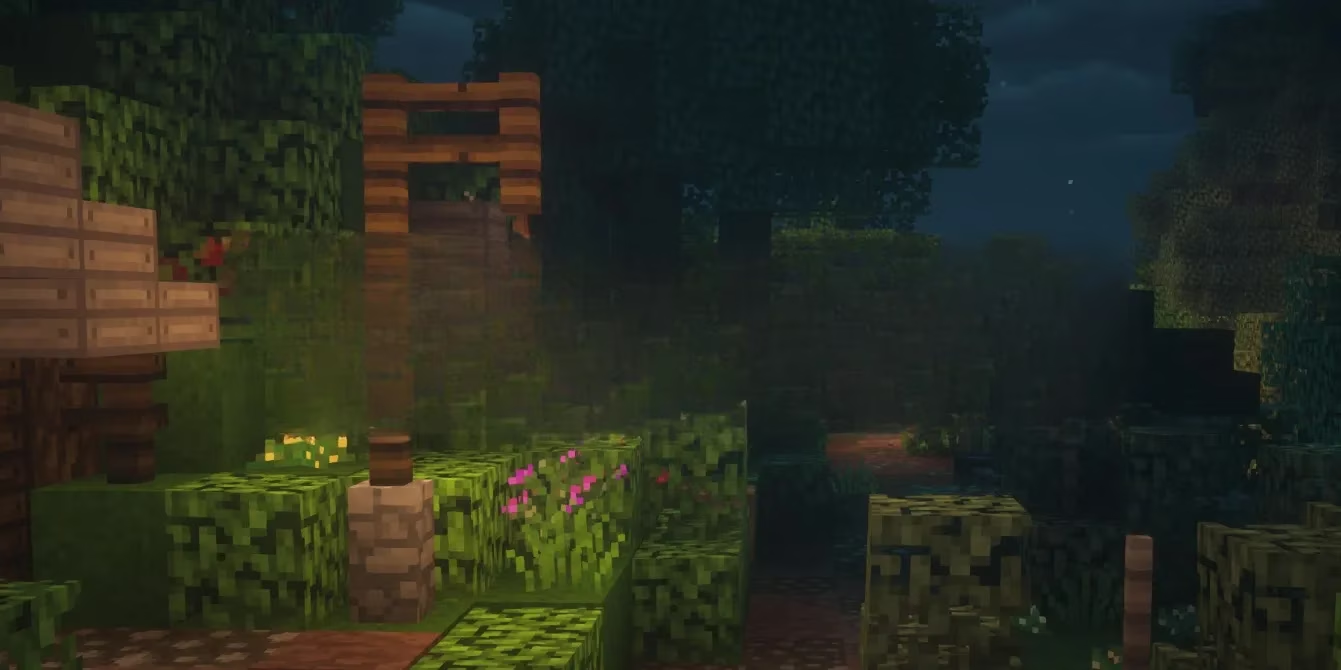
Roads would not be mere dirt lines; they would act like silver inlay in a kintsugi pot, turning the cracked separations between biomes into something intentional and beautiful. According to the proposal, a road biome would generate as a two-to-three-block-wide dirt path, stretching between major biomes rather than forming a standard region. It would be functionally similar to a river, meandering through the world and giving the terrain a kind of connective logic that many seeds currently lack. The road would not demand a massive overhaul; it would simply add a subtle lattice beneath the overworld, turning random scatter into a legible map.
The effects of such a change could ripple outward in strange and welcome directions. If villagers, outposts, and other structures were coded to spawn near roads with higher probability, the world would start to tell better stories. A path might lead from a desert village to a pillager outpost, hinting at old raids and simmering conflicts. A winding forest trail might be dotted with ruined portals or witch huts, making exploration feel less like a dice roll and more like following a narrative thread. A network of connected villages could form actual trade routes, while wandering merchants would finally look as though they were going somewhere instead of wandering in bewildered circles.
A table helps show the contrast:
| Feature | Current World Generation | Road Biome Concept |
|---|---|---|
| Villages | Scattered randomly | Clustered near paths and routes |
| Travel | Player-made or empty terrain | Pre-generated dirt pathways |
| Structures | Isolated points of interest | Linked into regional stories |
| Atmosphere | Fragmented islands | Cohesive, lived-in landscape |
The player behind the idea imagined roads as a circulatory system, pumping wandering traders, illager patrols, and even ordinary survival players through the once-isolated organs of the world. A two-block dirt path may seem modest, but in a game built around exploration, infrastructure is a quiet kind of magic. It can make a player glance east and think, I wonder where that trail goes, rather than simply sprinting toward the nearest unexplored chunk because there is no other cue. Survival builders might deliberately place a cabin along a road, not because it is efficient, but because the road makes the house feel as though it belongs to a wider story.
The hunger for better settlement design is not exactly new. Mojang has continued to add content, but villages and outposts have largely kept their simple, functional appearance. Players have filled that gap themselves. TrixyBlox's Ultimate Survival World became a well-known example of how much personality a vanilla-friendly rebuild could add, with each biome's village receiving an ambitious makeover while still respecting Minecraft's blocky vocabulary. But building custom roads remains cumbersome, and because roads do not generate when creating a new world, their aesthetic benefits often outweigh their practical ones. A dedicated road biome would bring that connective tissue into the game from the first chunk load.
By the time Version 1.21 arrived, it brought the armadillo, wolf armor made from armadillo scutes, new copper blocks with their own oxidation cycle, and Trial Chambers as a midgame combat test. Those additions gave players plenty to do, but they did not solve the deeper loneliness of an overworld where every point of interest feels separated by an indifferent sea of grass. The Birch Forest and Savanna biomes, long mentioned by the community as in need of an update, could also benefit from roads threading through them. Even without a full biome revamp, a simple path can change the emotional register of a landscape, making a birch grove feel like a corridor rather than a vague patch of white and green.
The proposal remains a small idea with an outsized imaginative pull. Roads would allow players to engage with the wider world of their Minecraft server, not just as a collection of coordinates, but as a place with direction, memory, and accident. Some survival characters would inevitably build houses along the road, not because the game told them to, but because the road quietly suggested that someone had been there before. In 2026, with years of updates still layering new creatures, blocks, and structures into the game, the road biome still feels like a missing seam in the overworld's huge patchwork jacket.
Mojang may never add a road biome exactly as Bus_Stop_Graffiti outlined, but the idea endures for the same reason players build bridges, light paths with lanterns, and carve staircases into mountains: Minecraft is not only about mining and crafting. It is about making a world that feels convincingly alive, and sometimes the shortest route to that feeling is a two-block-wide dirt path leading somewhere worth following.
Comments Area