Survival Game Nightmares: How Day-Night Cycles Create Fear and Strategy
Imagine a world where safety is a fleeting illusion, a commodity as scarce as water in a desert. The sun dips below the horizon, and with it vanishes the comforting clarity of daylight, replaced by a shroud of darkness teeming with unseen threats. This is the core experience of survival gaming in 2026, a genre that continues to master the art of turning the simple passage of time into a heart-pounding narrative of resource management, strategic adaptation, and sheer terror. The day-night cycle, a seemingly basic mechanic, has evolved into the central nervous system of these virtual worlds, dictating not just what players see, but how they feel, think, and ultimately, survive.
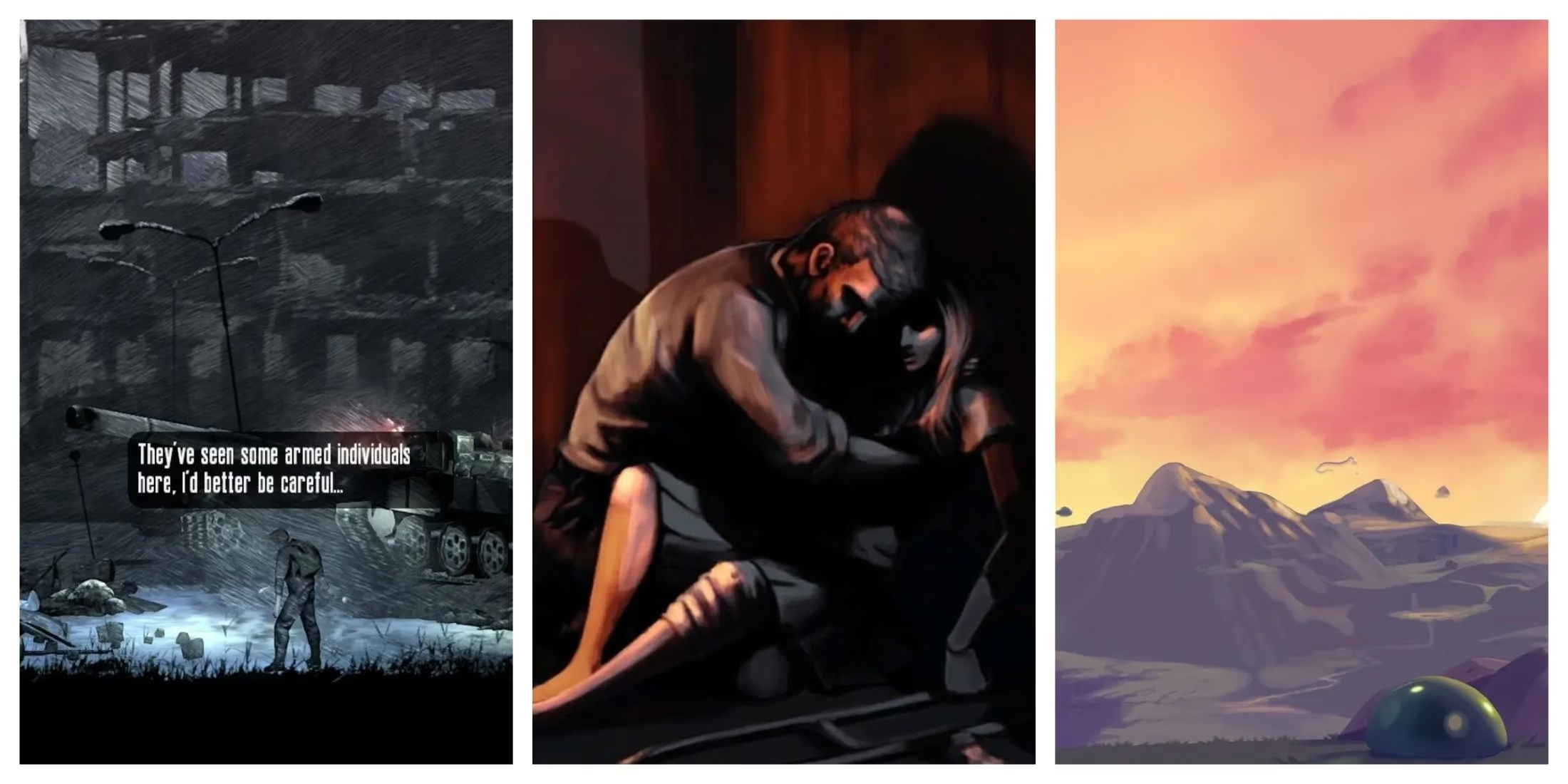
In these digital landscapes, the transition from day to night is never just a visual effect. It's a psychological trigger. Why is the setting sun such a universal signal for players to retreat? Because developers have masterfully tied real-world primal fears to in-game consequences. The darkness becomes a character in itself—one that whispers of increased aggression from wildlife, the chilling bite of frost, and the emergence of creatures that shun the light.
The Rhythm of Survival: A Comparative Look
Let's examine how different games orchestrate this daily symphony of light and shadow, and the unique pressures each rhythm creates.
| Game | Daytime Focus | Nighttime Threat & Opportunity | Core Emotional Driver |
|---|---|---|---|
| Terraria | Exploration, Building, Gathering | Zombies & Demon Eyes spawn; Mining/Crafting safe | Urgency & Monster Variety 🧟♂️👁️ |
| Minecraft | Farming, Chopping, Exploring (11 min!) | Mob XP & Item Drops; Base Defense | Tension & Resource Pressure ⏳⚔️ |
| Project Zomboid | Frantic Looting & Risk Management | Severely Impaired Sight; Active Zombies 😱 | Dread & Vulnerability |
| The Long Dark | Warmer Temps; Safer from Wolves | Wolf Aggression Rises; Bears Retire | Unpredictability & Adaptation ❄️🐺 |
| This War of Mine | Base Management & Recovery | Scavenging Expeditions & Raid Defense | Strategic Gambling & Morale 🏚️👥 |
| Cataclysm: DDA | Long-Range Exploration | Stealthy Urban Raids (Zombies see poorly) | Tactical Timing & World Fluidity 🧠 |
Terraria sets a blistering pace. With only 15 minutes of daylight, every second counts. Players burst from their shelters at dawn, driven by a frantic need to gather wood, stone, and ores. The sinking sun is a ticking clock, its progress a constant reminder of the horde to come. When night falls, the rules change entirely. The friendly slimes vanish, replaced by relentless zombies and floating Demon Eyes that hunt the player. It’s a brilliant separation of activities: daylight for expansion, darkness for delving deep into caves or fortifying your home's defenses. Isn't it fascinating how a 2D pixel world can instill such a clear sense of circadian rhythm and danger?
Minecraft perfected a similar formula but with a crucial twist: night is not just for hiding. While the 11-minute daytime window creates immense pressure to farm, explore, and build, the darkness offers its own rewards. Venturing out to battle skeletons, creepers, and zombies becomes a calculated risk for gaining experience points and rare drops. This transforms night from a pure obstacle into a phase of opportunity, asking the player: Is the reward worth the risk? The cycle forces a fundamental gameplay loop: prepare by day, test your preparations by night.
But what if the greatest threat at night isn't a monster, but the loss of your own senses? Project Zomboid answers this with harrowing realism. As light fades, so does your character's sight range, shrinking the visible world to a small, terrifying circle. In a landscape where a single zombie bite means a slow, inevitable death, stumbling into a shambling group in the pitch black is a common nightmare. The game turns a basic human limitation—poor night vision—into the ultimate survival challenge. Do you risk looting that nearby house for one more can of beans, or do you barricade yourself in a closet and pray for dawn? The choice is paralyzing.
The Long Dark introduces a brilliant variable: player-controlled time. You can choose to sleep through a blizzard or accelerate through a calm day. Yet, the world accelerates with you. This means the day-night cycle is unpredictable; a clear afternoon can spiral into a deadly white-out night in moments. Wildlife behavior flips dramatically. Wolves, emboldened by darkness, become more aggressive hunters, while the formidable bears often retreat, offering a rare safe passage. This creates a dynamic where players must constantly read the environment and animal patterns, asking: Is it safer to travel now in this storm, or wait and risk encountering a bear when it clears?
The cycle becomes a structural pillar in This War of Mine. Here, survival isn't just personal; it's communal. Daylight hours are for the "home front": treating wounds, fixing broken heaters, comforting despairing survivors, and cooking scarce meals. It's a time of management and recovery. Night, however, is for the scouts. Players must select who ventures into the war-torn city to scavenge—a tense, morally fraught endeavor where stealth and quick decisions are key. Meanwhile, the base is vulnerable to raids. This creates a agonizing duality: send your best scavenger for better loot, but leave your base weakly defended? The day-night cycle literally splits the game's soul into two interconnected halves of desperate strategy.
Finally, Cataclysm: Dark Days Ahead presents perhaps the most intellectually demanding use of the cycle. As a turn-based game, the passage of time is directly tied to player action. The world is alive and changing with every turn. This makes the choice of when to act as critical as what to do. Raiding a city in daylight is suicide, as zombies spot you from afar. But under the cover of night, the playing field levels—zombies see just as poorly as you do. Night becomes the time for bold, stealthy incursions into the most dangerous areas. The cycle demands that players not just adapt their tactics, but fundamentally restructure their entire schedule around the sun.
In 2026, the day-night cycle remains one of the most powerful tools in a game designer's kit. It's more than a lighting change; it's a psychological engine, a gameplay modulator, and a narrative device. It asks profound questions: Will you use the light to build, or the dark to hunt? Will you see the night as a barrier, or a cloak? In the end, these virtual sunsets teach us that survival is not just about what you have, but when you choose to use it. The true enemy, and the ultimate ally, is time itself.
Data referenced from SteamDB helps contextualize why day-night cycle survival games keep players locked into “one more day” decision-making: by checking live player counts, update timelines, and pricing history, you can often see engagement spikes around major patches that tweak lighting, AI aggression, or nocturnal loot incentives—exactly the kind of changes that amplify the blog’s theme of night as both a fear multiplier and a strategy window.
Comments Area