Just How Big Is a Minecraft World? A Player’s Deep Dive into Blocky Infinity
I still remember the awe I felt when I first spawned in a new Minecraft world. The horizon stretched on forever, a patchwork of biomes rolling into the distance with no visible end. Procedural generation is like a master storyteller who never repeats a tale—every seed whispers a unique landscape into existence. But eventually, I started wondering: just how vast is this digital universe I’ve been losing myself in? If you’ve ever paused your mining to ponder that same question, let’s dig into the staggering numbers together.
Before we measure the world, we need to understand its fundamental building blocks—or rather, its building chunks. A chunk is a 16×16 block column that runs from the deepest bedrock to the build height limit. Think of chunks as the world’s atomic cells, each one a tiny 16×16 canvas repeated across the landscape like an infinite chessboard where every square holds secrets. As of 2026, the vertical reach spans from Y=-64 to Y=320, meaning each chunk contains up to 98,304 potential blocks if every air space were filled. That’s a lot of material, but a single chunk is only a postage stamp on the sprawling envelope of the world.
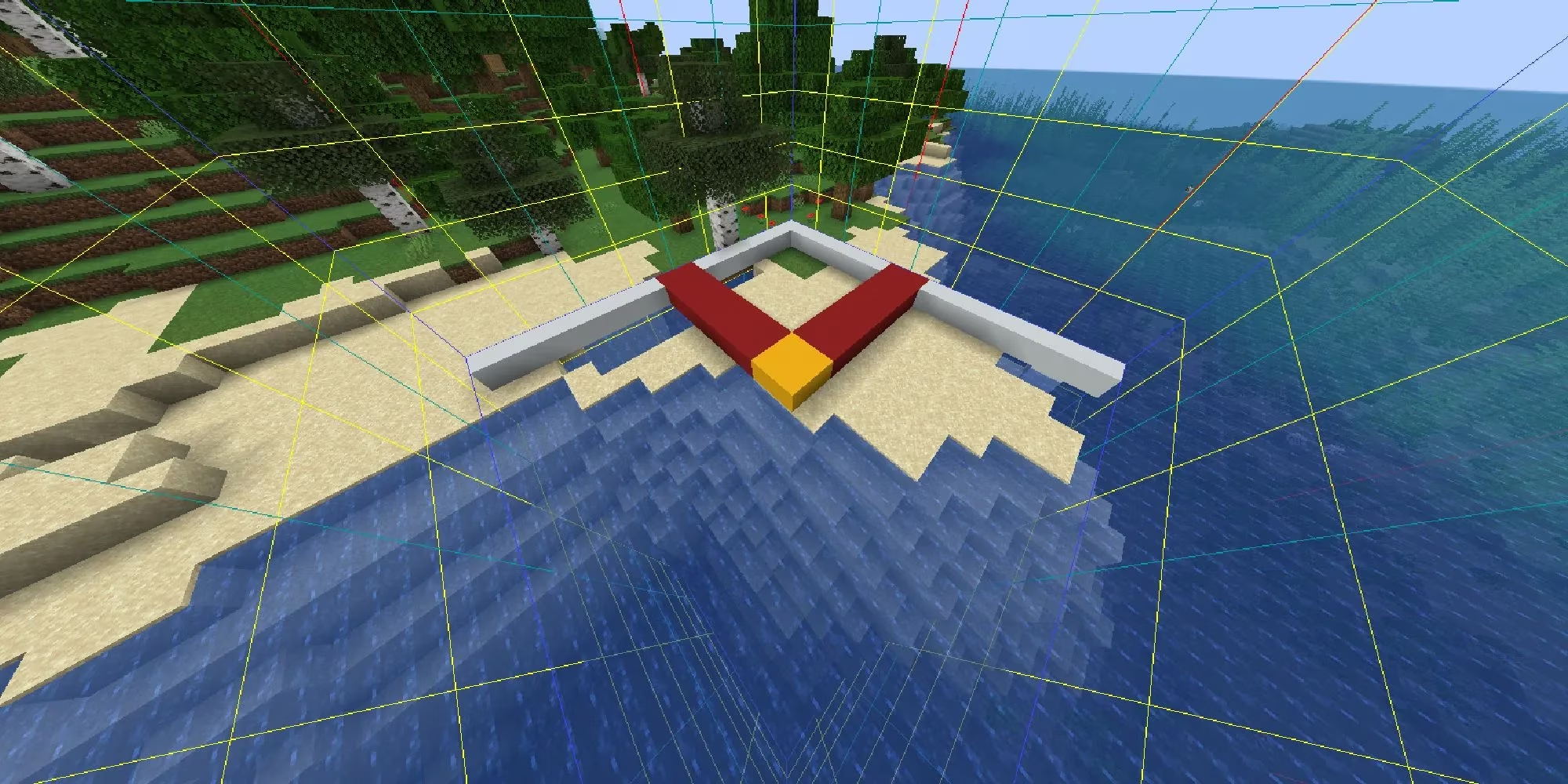
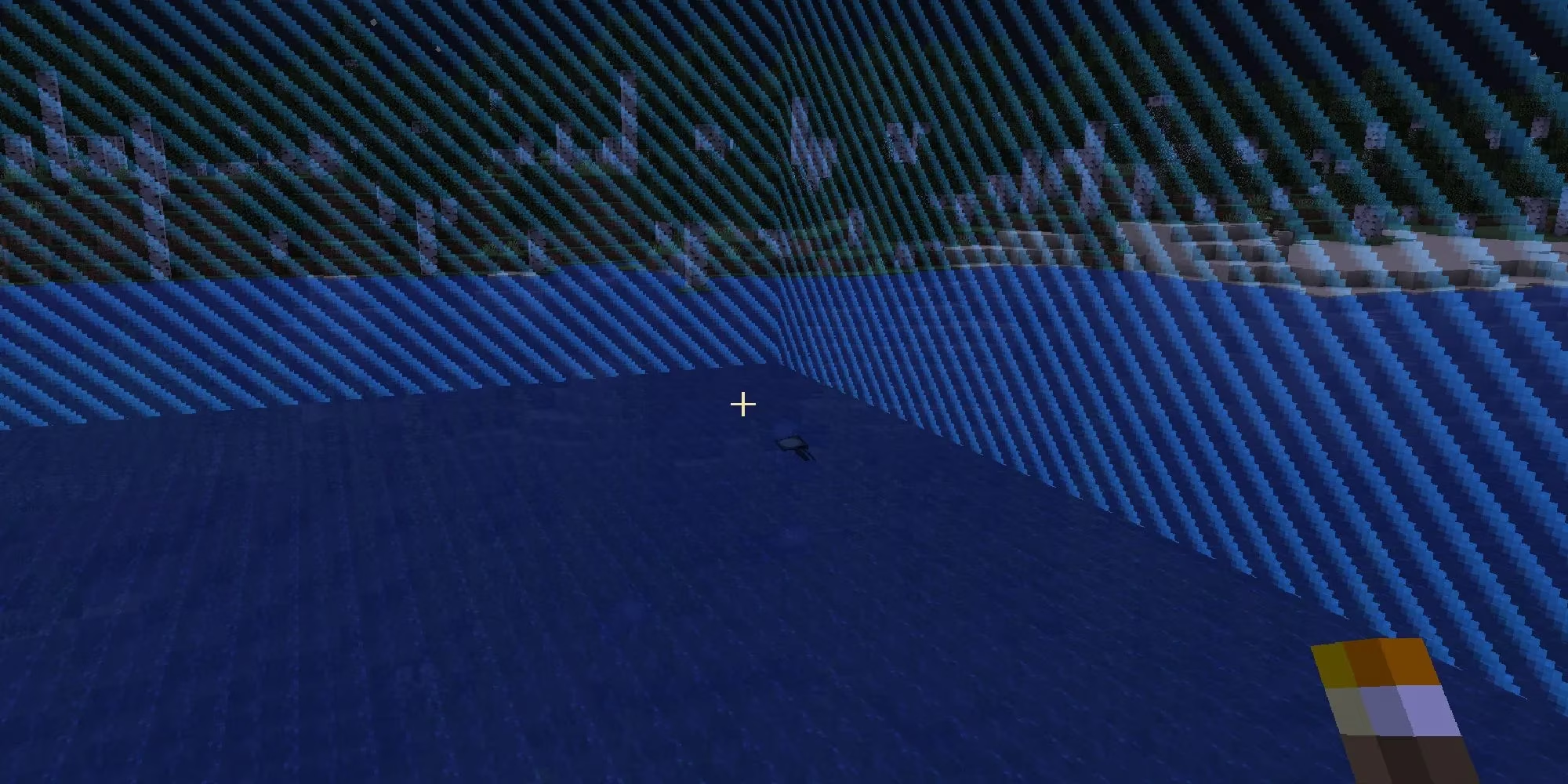
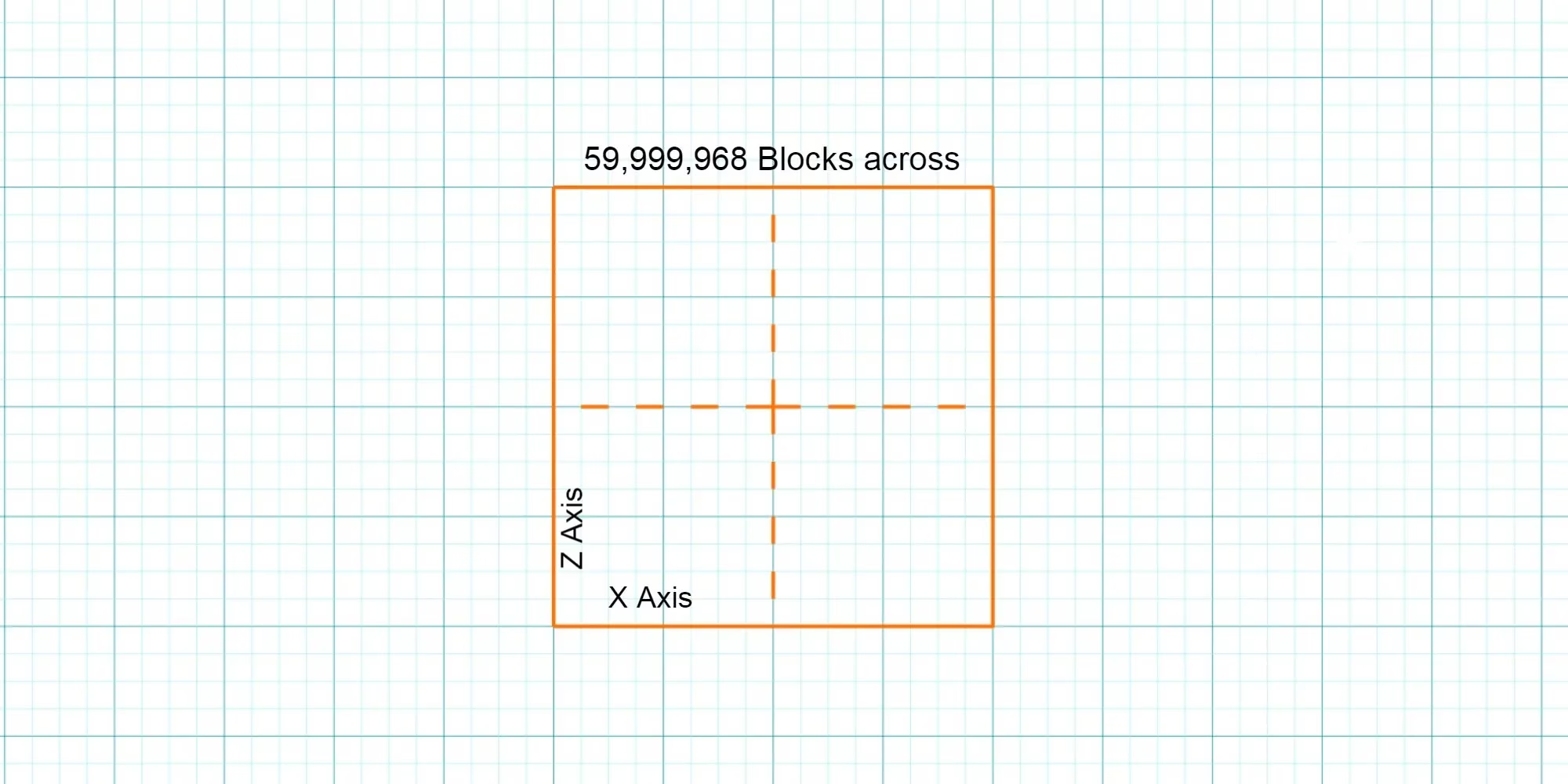
So where does this envelope end? The world border is a silent, unbreakable wall that feels less like a fence and more like the edge of a snow globe—an invisible curvature that says, “This far, and no further.” For both the X and Z coordinates, the border stands at ±29,999,984 blocks from the origin point. Walk in any cardinal direction, and after nearly thirty million blocks, you’ll meet that translucent barrier. From one edge to the opposite side, through the zero point, the distance doubles to an eye-watering 59,999,968 blocks. I picture it like standing on one shore of an ocean and knowing the far coast is 30 million blocks away—but the ocean is made of stone, grass, and the occasional creeper.
Now let’s talk surface area, because that’s where the numbers start to feel truly cosmic. To calculate the total number of chunks along one axis, we multiply the full span (59,999,968 blocks) by the number of chunks, but it’s simpler to say there are 3,750,000 chunks from one X border to the other. Since the world is a square, we square that chunk count: 3,750,000 × 3,750,000 gives us 14,062,500,000,000 chunks. That’s over fourteen trillion tiny chessboards. Convert that to block surface area by multiplying by the 256 blocks per chunk floor (16×16), and you land on a dizzying 3,599,996,160,001,024 blocks. For a sense of scale, imagine spreading those blocks across the real Earth’s land surface—each block is one meter, so you’d cover the planet in a layer of Minecraft cubes several times over.
If you decided to trek from one border to the other, the journey would be a pilgrimage of 59,999,968 meters—equivalent to about 59,999 kilometers or 37,282 miles. To put that into perspective, Earth’s polar circumference is roughly 40,000 kilometers. Walking across a Minecraft world is like circling our planet one and a half times, except you’d be navigating floating islands and lava pools instead of oceans. How long would it take? If you walked non-stop at a steady 5.6 blocks per second (the base walking speed), it would consume over 3,000 hours—around 125 days of continuous travel. That’s an entire season of your life spent simply moving forward, and you’d still only have crossed half the width if you stopped before the far border.
But the surface is only the beginning. The world has depth, and depth brings volume. Volume is the measure of all the space that could contain a block, from the lowest bedrock to the sky limit. Each chunk’s volume is 98,304 blocks (16×16×384 layers). Multiplying by the total number of chunks—14,062,500,000,000—we get a volume of 1,352,400,000,000,000,000 blocks. That’s 1.3524 × 10¹⁸, a number so colossal that most calculators simply surrender and display it in scientific notation. I like to think of this volume as a gargantuan sea of potential matter, each block a drop waiting to be shaped into castles, redstone contraptions, or entire cities. If every person on Earth were given an equal share of this volume, we’d each have about 170 million blocks to play with—a personal creative sandbox larger than most cities.
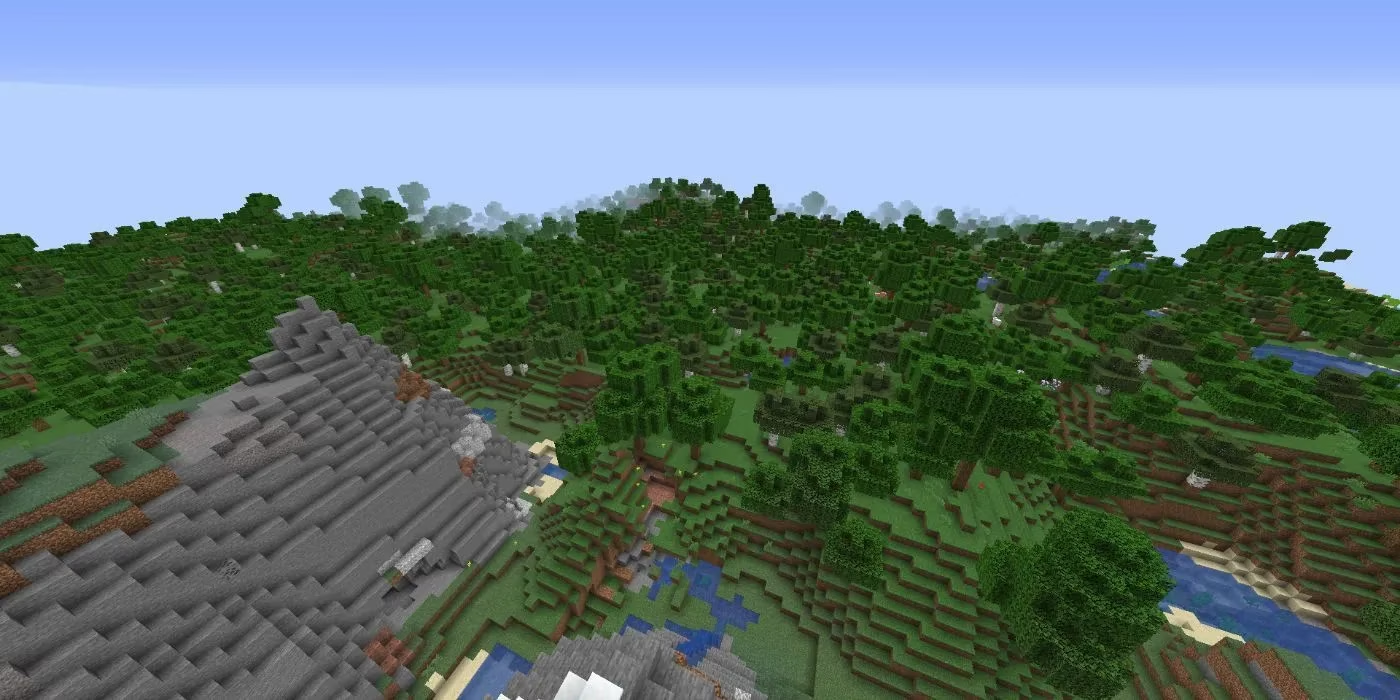
Reflecting on these numbers makes me appreciate the quiet genius of Minecraft’s design. The world isn’t truly infinite, but it might as well be for any single player. The borders exist as a practical limit, preventing the game from collapsing under its own procedural weight, yet they feel like gentle suggestions in a universe where creativity knows no bounds. Every time I place a block or explore a new cave, I’m wandering inside a vast digital continent that could house a thousand stories. And here’s the kicker: with a new seed, the same colossal canvas resets, offering a fresh arrangement of those 1.35 quintillion blocks. It’s a playground so large that even after years of exploration, I’ve only scratched the surface—and that, I think, is the true magic behind the question of how big a Minecraft world really is.
Comments Area