A Lone House in the Blocky Void: My Strangest Minecraft Village
I remember the afternoon as if it had been etched into a corrupted chunk file—the sun slanting through my window while I loaded up a legacy version of Minecraft, nostalgic for the simpler geometry of 2012. The world I generated that day in 2026 was unremarkable at first: a sparse birch forest, undulating plains, and the distant murmur of a cave. After ten minutes of wandering, I crested a small hill and stopped dead. Below me, pressed against a river, stood a village composed of exactly one house. Not a cluster of wattle-and-daub huts with wandering iron golems, not the familiar hum of farmers trading carrots, but a solitary structure capped by a wooden roof and surrounded by nothing but grass. It felt less like a settlement and more like a single misspelled word in an epic novel—impossible to unsee once you’ve spotted it.
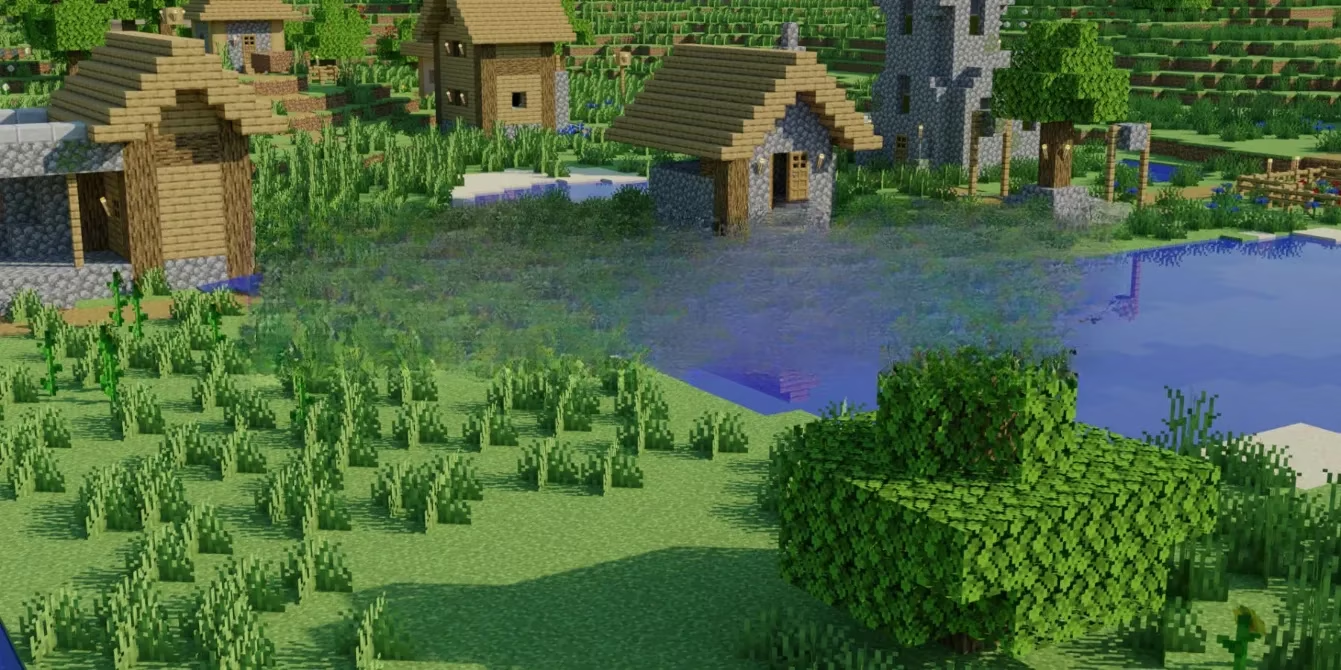
Minecraft thrives on the predictable magic of procedural generation. Villages are among the game’s most beloved features: bustling constellations of houses, farms, bell towers, and occasionally a nitwit staring at a fence post. Encountering a village with only one building is akin to hearing an orchestra hit a single note and then fall completely silent—it’s unnerving, almost liminal. As I circled the lonely house, I felt that old creepypasta tingle, the one that had players whispering about Herobrine in the alpha days. Empty worlds in older Minecraft builds have a knack for evoking that hollow, backroom-type dread; they are the equivalent of a ghost ship drifting on a procedural sea, a solitary buoy in an algorithm that forgot to populate the rest of the marina.
The discovery wasn’t unprecedented. In 2024, a Reddit user named TheStickiestJug shared a remarkably similar find, sparking a flurry of technical explanations. Community sleuths pointed out that legacy editions could stumble during world generation, especially if a previous world had been loaded before creating a new one—a bug that would halt village generation after placing just the first structure. This bug acts like a skipping record needle on a vinyl of code, jumping tracks before the full symphony of buildings can play out. But knowing the technical cause didn’t diminish the spectacle. If anything, it deepened my appreciation for Minecraft’s accidental artistry. These anomalies remind us that the game’s codebase, for all its polish, still harbors tiny glitches that blossom into memorable anomalies.
I shared a screenshot of my one-house village on a small Discord server later that evening. Responses flooded in: one friend opined that it felt like a fairy-tale cottage abandoned by a geometry-defiant witch; another said it reminded him of when a video game’s simulation simply gives up. This kind of reaction is precisely why Minecraft retains its gravitational pull even in 2026. The game’s longevity isn’t solely attributable to Mojang’s steady cadence of updates—though the recent Bundles of Bravery drop and the much-anticipated Tricky Trials overhaul, complete with trial chambers, autocrafters, and the new mace weapon, have certainly kept the meta fresh. Rather, Minecraft endures because it serves as a canvas for emergent storytelling. Every glitch, every cut-off village, every chunk error becomes a personal legend.
Beyond the nostalgia trip, moments like this punctuate a larger truth about sandbox games: their imperfections become their folklore. Old versions of Minecraft, in particular, conjure a specific breed of loneliness that more populated versions cannot. In these legacy builds, the so-called “liminal space” effect transforms a missing village into an existential puzzle. You start to wonder who was meant to live in that lone house—a lone cleric tinkering with brewing stands, perhaps, or a farmer doomed to trade with no one. The emptiness swells with imaginary narratives, a phenomenon that could never be replicated by a perfectly spawned city of fifty villagers.
Sitting atop that hill, I did what any self-respecting Minecraft player would do: I jumped down, punched the door open, and claimed the house as my own. I planted a bed, lit a torch, and spent the night listening to the phantom cries of no one. The next morning, I began building a new village around it, as if I were a caretaker repopulating a post-apocalyptic memory. By dusk, I had laid out three extra plots, all organized around that uncanny original structure. That house—a fluke of buggy code—had become the cornerstone of my entire world. It taught me that Minecraft isn’t just about the content developers add; it’s about the stories the engine fails to hide, the beautiful accidents that spark our imagination. And as I type this, the 2026 Minecraft landscape is still riddled with such glimmers: from the newly introduced artist-designed paintings by Sarah Boeving to the specter of older bugs lingering in legacy launchers, every session holds the potential for a discovery that feels entirely my own. The lone house wasn’t a mistake—it was an invitation.
Comments Area